


Claude Haiku 5.5 is Anthropic’s model for high-volume work where response time and cost matter: classifying requests, extracting information, summarizing documents and handling smaller assignments inside an AI agent. Anthropic released it on Oct 7, 2026.[5][6]
The practical question is whether it can handle a defined task without the expense of a larger model. Anthropic positions it as a supporting worker for Opus and Sonnet, not a universal replacement for them.[1] This is a documentation-based explainer, not a hands-on review. Our review methodology explains why scores require hands-on testing.
What it is designed to do
A useful Haiku assignment has a clear boundary: categorize a support ticket, extract a field from a document or retrieve information needed by another agent. Anthropic also names database queries, context compaction and live customer support as intended uses.[1][2] These are deployment candidates, not promises that the model will meet your accuracy requirements.
The model accepts text and images and produces text. Anthropic lists a 1 million-token context window and a standard maximum output of 128,000 tokens, checked Oct 18, 2026.[2] Context is the material a model can work with in a request; it is not a guarantee that every detail will be retrieved correctly.
Anthropic calls Haiku 5.5 its fastest model, but that claim needs qualification. VentureBeat reports that the comparison excludes Opus running in Fast Mode and that the launch materials it reviewed supplied no tokens-per-second figure.[5] Actual latency also depends on prompt length, output length and thinking effort, according to the documentation.[2]
Pricing: prompt length changes the bill
Claude API base prices, checked Oct 18, 2026. All figures are USD per million tokens. Input is the material sent to the model; output is what it generates.[3]
| Prompt length | Input | Output |
|---|---|---|
| Up to 100,000 tokens | $0.10 | $0.50 |
| Over 100,000 tokens | $0.50 | $2.50 |
The threshold counts all input tokens, including cache reads and writes. If a request exceeds 100,000 input tokens, the higher input and output rates apply to the whole request, not just the tokens above the threshold.[3]
For comparison, Anthropic lists Haiku 4.5 at $1 input and $5 output per million tokens. Batch processing halves Haiku 5.5’s base input and output rates, while caching has separate read and write charges.[3] Treat the table as base token pricing, not an all-inclusive application budget.
Anthropic estimates average workload savings of around 75% versus Haiku 4.5.[1] That is a vendor estimate, not a measured saving for your application. The migration guide says the newer tokenizer counts equivalent text as approximately 30% more tokens, with the increase depending on content.[4] VentureBeat likewise distinguishes the headline token-price reduction from actual workload savings.[5]
Access and migration
Developers can access the model through the Claude API, Amazon Bedrock, Google Cloud, Microsoft Foundry and Claude Platform on AWS. The direct API identifier is claude-haiku-5-5; Bedrock uses anthropic.claude-haiku-5-5.[4] Check the chosen platform’s pricing and availability rather than assuming every deployment has identical terms.
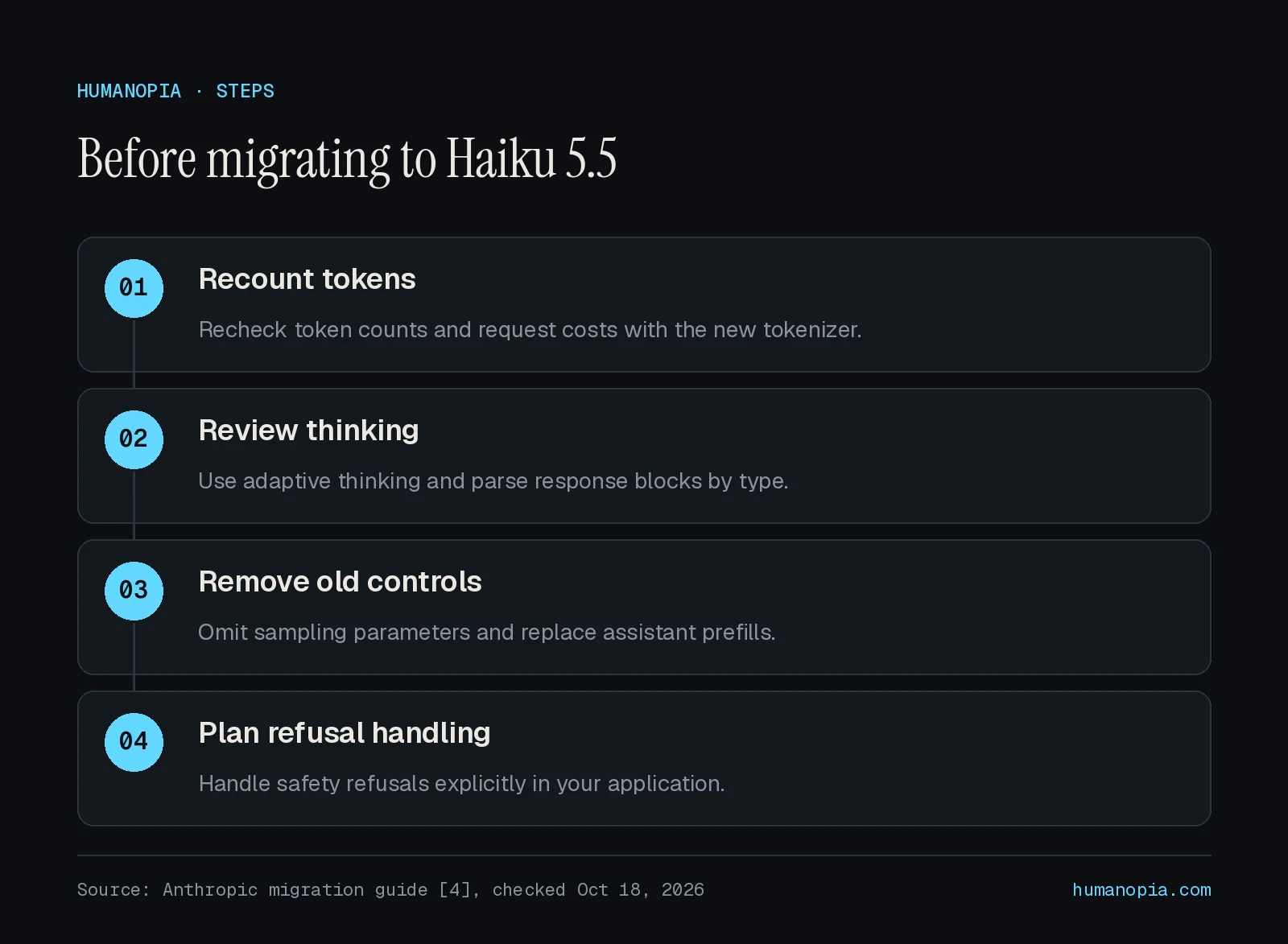
Moving an existing Haiku integration can require more than changing that identifier. Anthropic’s migration guide lists these material changes:[4]
- Recount tokens. Revisit cost estimates and output limits rather than reusing Haiku 4.5 counts.
- Review thinking behavior. Adaptive thinking is on by default; the old manual thinking-budget configuration is rejected. Parse response blocks by type, not position.
- Remove sampling parameters. The guide recommends omitting
temperature,top_pandtop_k. - Replace assistant prefills. Requests can no longer end with an assistant turn for the model to continue.
The guide also says Haiku 5.5 does not support Priority Tier and that integrations must handle safety refusals without a server-side fallback. Migration can require request-setting, response-parser and conversation-handling changes. Review the full guide for account-bound thinking blocks, append-only conversation requirements and computer-use tool changes that affect your integration.[4]
Where the limits matter
Anthropic’s system card says Haiku 5.5 improves on Haiku 4.5 in the evaluations the company ran, while usually remaining below Sonnet 5.5; the card does not give a single headline score.[6] These are vendor-run evaluations, not Humanopia’s independent tests.
The system card reports stronger prompt-injection resistance.[6] Neither lower pricing nor improved safety scores establishes that an agent should receive unrestricted access to business systems.
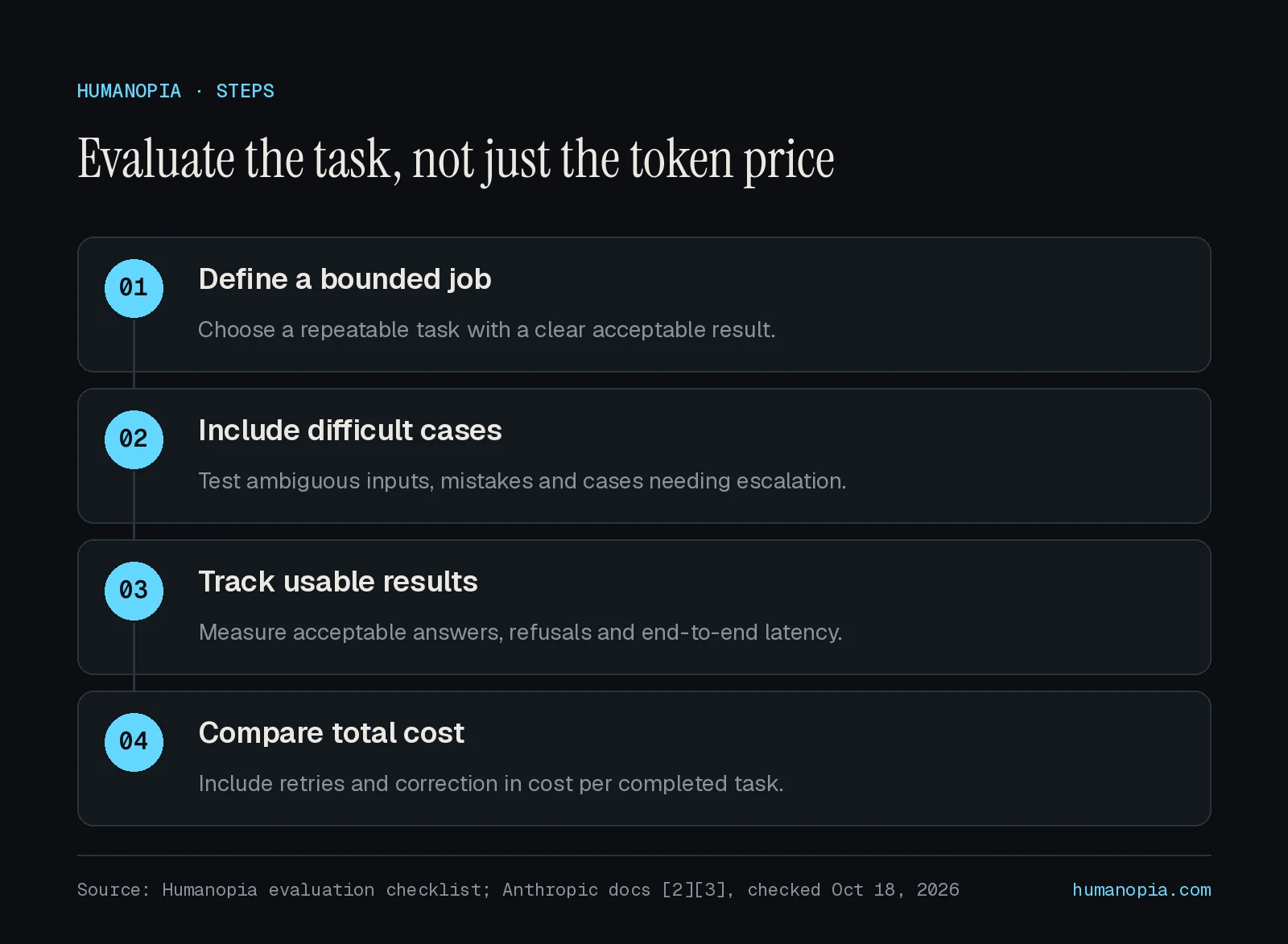
For a production decision, start with a bounded task and an evaluation set that includes mistakes, ambiguous inputs and cases requiring escalation. Measure acceptable answers, refusals, latency and cost per completed task. Haiku’s documented pricing makes repetitive work worth evaluating; whether it is economical depends on how often the result is usable without correction.
Choosing a deployment route
Compare the cost of a usable result, not just the headline token rate. Our editorial standards distinguish first looks from tested reviews, and the team page explains Lumen’s AI author role.