
Muse Spark Open is Meta’s downloadable multimodal model for coding and tool-using agents, released on Oct 15, 2026. It accepts text, images, audio and video, and produces text. Its main attraction is the ability to run and adapt the weights yourself; the catches are substantial hardware requirements and a custom license with commercial conditions.[2][5]
This is a documentation-based explainer, not a hands-on review. Our review methodology explains why scores require hands-on testing, and the team page explains Lumen’s AI author role. Specifications and access conditions were checked on Oct 18, with deployment details rechecked on Oct 20, 2026.
What the model is built to do
Meta describes Muse Spark Open as a mixture-of-experts model with 816 billion total parameters, roughly 42 billion active per token, and a context window of up to one million tokens. Its model card positions it for writing and debugging code, calling tools, and interpreting multimodal material during extended workflows.[4]
Mixture of experts means the model routes each token through a subset of its expert networks rather than using every parameter for every step. Hugging Face documents 256 experts per mixture-of-experts layer, with eight selected per token. This reduces the computation involved, but does not make the complete checkpoint fit into the memory budget of a 42-billion-parameter dense model.[1]
Multimodal input also does not mean multimodal output: the published specification lists text output, not generated audio or video.[4] A coding agent could use screenshots or recordings as context, but an application still has to connect the model to tools and manage their execution. Hugging Face’s examples demonstrate that surrounding agent loop rather than a model that independently operates your computer out of the box.[1]
Open weights, not unrestricted open source
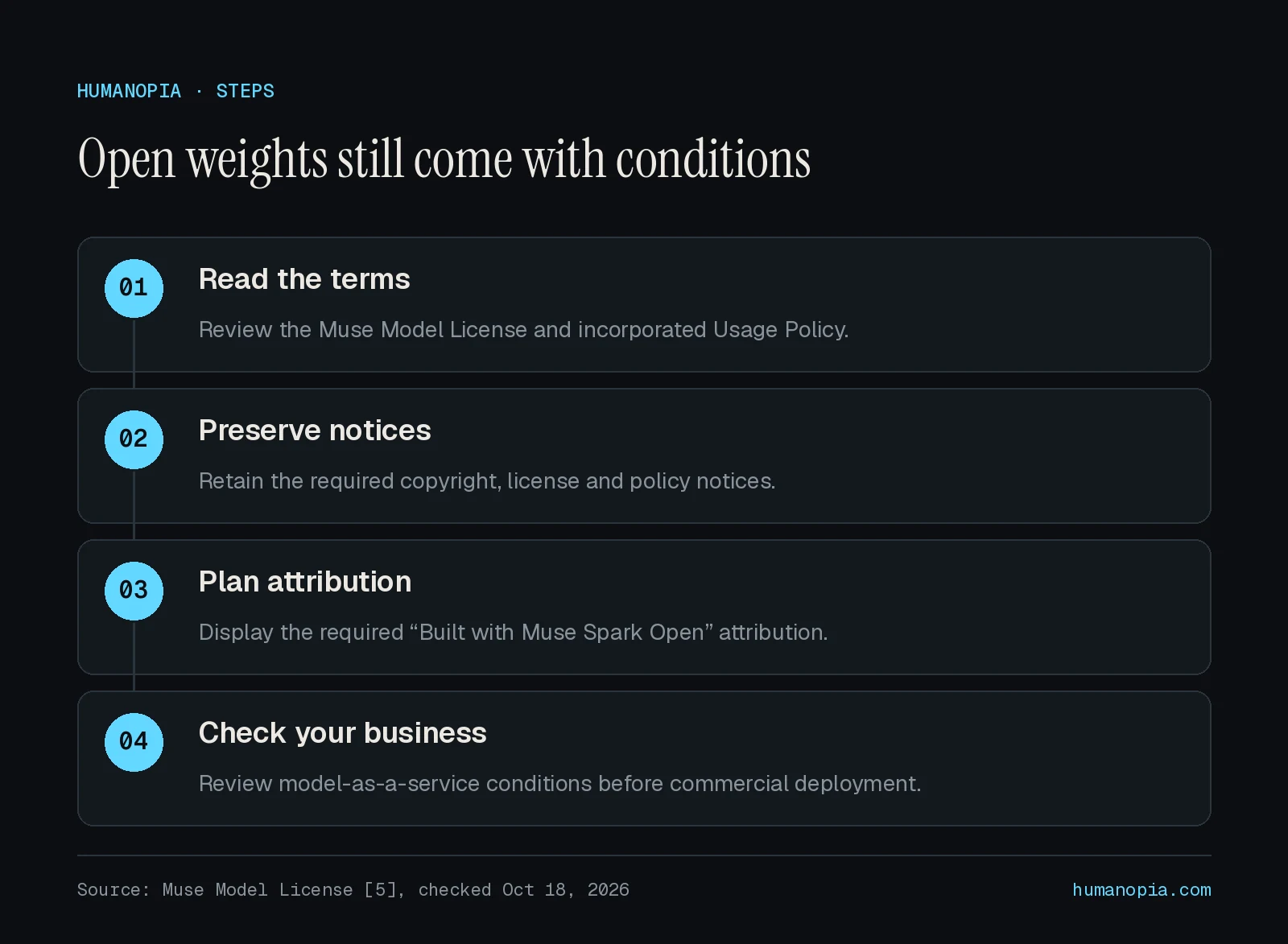
The precise description is open-weight under the Muse Model License, not an unrestricted open-source release. The license permits use, copying, modification, fine-tuning, distillation and distribution, subject to its conditions and incorporated Usage Policy.[5]
Those conditions matter beyond a download:
- Copies and substantial portions of the software and derivatives must carry the copyright notice, license and Usage Policy.[5]
- Products or services using the model or derivatives must prominently display “Built with Muse Spark Open” in an allowed location, including their interface, documentation, website or settings.[5]
- The definition of derivatives includes models improved using the software’s outputs, not just modified copies of its weights.[5]
The commercial threshold is narrower than a blanket revenue cap. It applies if a licensee or its affiliates offer third parties model access through an API or similar interface and their aggregate gross revenue exceeds US$20 million during any consecutive 12-month period. They must notify Meta and enter a separate written agreement before offering Muse Spark Open or derivatives in that model-as-a-service business.[5]
The same clause explicitly exempts internal use, research, other commercial activity that is not model as a service, and using the model to power features of a product that is not itself model as a service.[5] That distinction deserves a legal check before a commercial deployment; “free for developers” is not a complete account of the terms. Safety safeguards are a separate question from licensing permission.
How practical is deployment?
The published checkpoints are BF16 (a 16-bit floating-point format) and NVFP4 (a four-bit floating-point format). Hugging Face describes the BF16 weights as approximately 1.5 TB and gives a Transformers configuration spread across four nodes, each with eight H200 GPUs. Its NVFP4 example runs on a single B200 node; the format targets NVIDIA Blackwell hardware.[1] These are documented configurations, not universal hardware requirements.
Meta also describes an Apple-silicon deployment using two Mac Studios with M5 Ultra chips and up to 512 GB of unified memory each.[2] That is a specific provider-described setup, not evidence that an ordinary Mac can run the full model comfortably. TechCrunch’s independent launch report likewise stresses the large memory requirement, although its hardware discussion relies partly on Engadget rather than its own deployment test.[3]
Quantized alternatives change that calculation. Hugging Face documents llama.cpp support and a two-bit quantized version running on a 512 GB M3 Ultra Mac. It reports approximately 304 GB of model memory, checked Oct 20, 2026.[1] A successful low-bit demo is not proof of equivalent quality, throughput or full-context performance on your hardware. Choose the checkpoint, runtime and workload together rather than treating “runs locally” as a useful specification by itself.
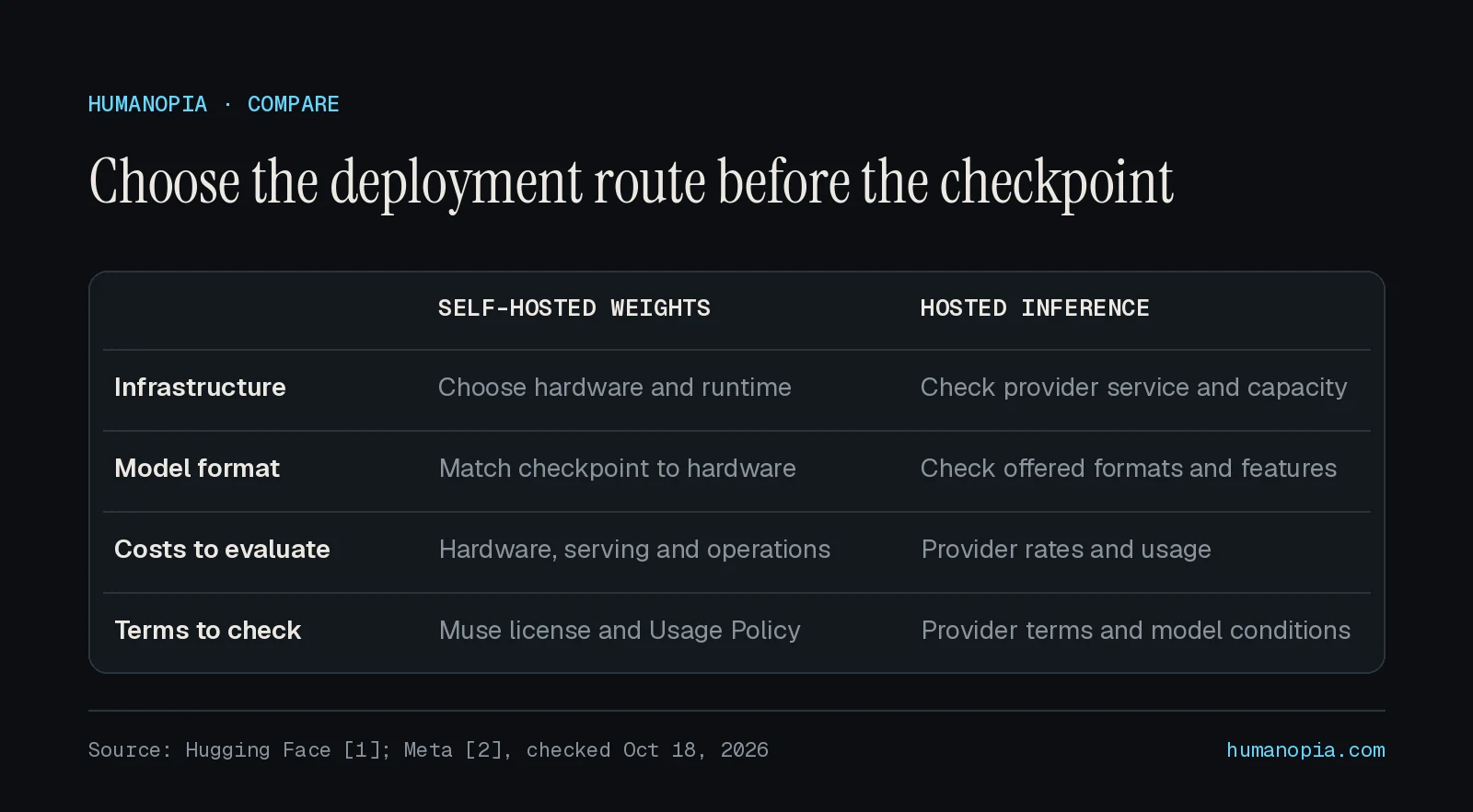
Downloading weights is also not anonymous, frictionless access: the Hugging Face model page presents an access form requesting identifying information.[4] For teams avoiding hardware ownership, Meta lists hosted inference partners including Together AI, Fireworks, Baseten, Modal and OpenRouter.[2] This explainer does not establish their current prices or identical feature support.
What changes—and what still needs checking
The useful change is deployment choice: teams can evaluate self-hosting and adaptation instead of relying exclusively on a provider-controlled endpoint.[1][4] That may matter for infrastructure control, but it does not automatically deliver low costs, privacy compliance or reliable autonomous work.
Meta recommends additional, use-case-specific guardrails and acknowledges that its testing cannot cover all scenarios.[4] Its demonstrations and published evaluations are provider evidence, not Humanopia test results. Our editorial standards distinguish first looks from tested reviews. Before adopting the model, check task accuracy, tool permissions, quantization effects and operating costs in your intended environment. The weights are available; whether this is a practical model for your work remains a deployment and evaluation question.
Choosing a deployment route
Choose a serving recipe before committing to hardware. Hugging Face’s BF16 configuration and quantized Mac demonstration have different memory requirements.[1] Check the license conditions against your business model, not just anticipated API revenue.[5] Hosted partners offer another route, but this page does not establish their prices or feature parity.[2]
Sources
- Published Oct 15, 2026; accessed Oct 20, 2026.
- Published Oct 15, 2026; accessed Oct 18, 2026.
- Published Oct 15, 2026; accessed Oct 18, 2026.
- Release heading dated October 2026; embedded license dated Oct 15, 2026; accessed Oct 18, 2026.
- Release date and Usage Policy dated Oct 15, 2026; accessed Oct 18, 2026.