

Gemini 4 Argon is Google’s flagship reasoning model for demanding coding, research and multi-step work. Google opened access to developers, enterprises and paying consumer subscribers on Oct 13, 2026. The release is about giving a model more room to work through a problem—not making every Gemini feature available free of charge.[1][2]
The distinction between model and product matters. Argon is the underlying model; the Gemini app, AI Studio and Antigravity are different ways to use it, with different access conditions. This profile is based on documentation and independent reporting, not Humanopia hands-on testing.[1][6] Our review methodology explains why scores require hands-on testing.
Where you can use it
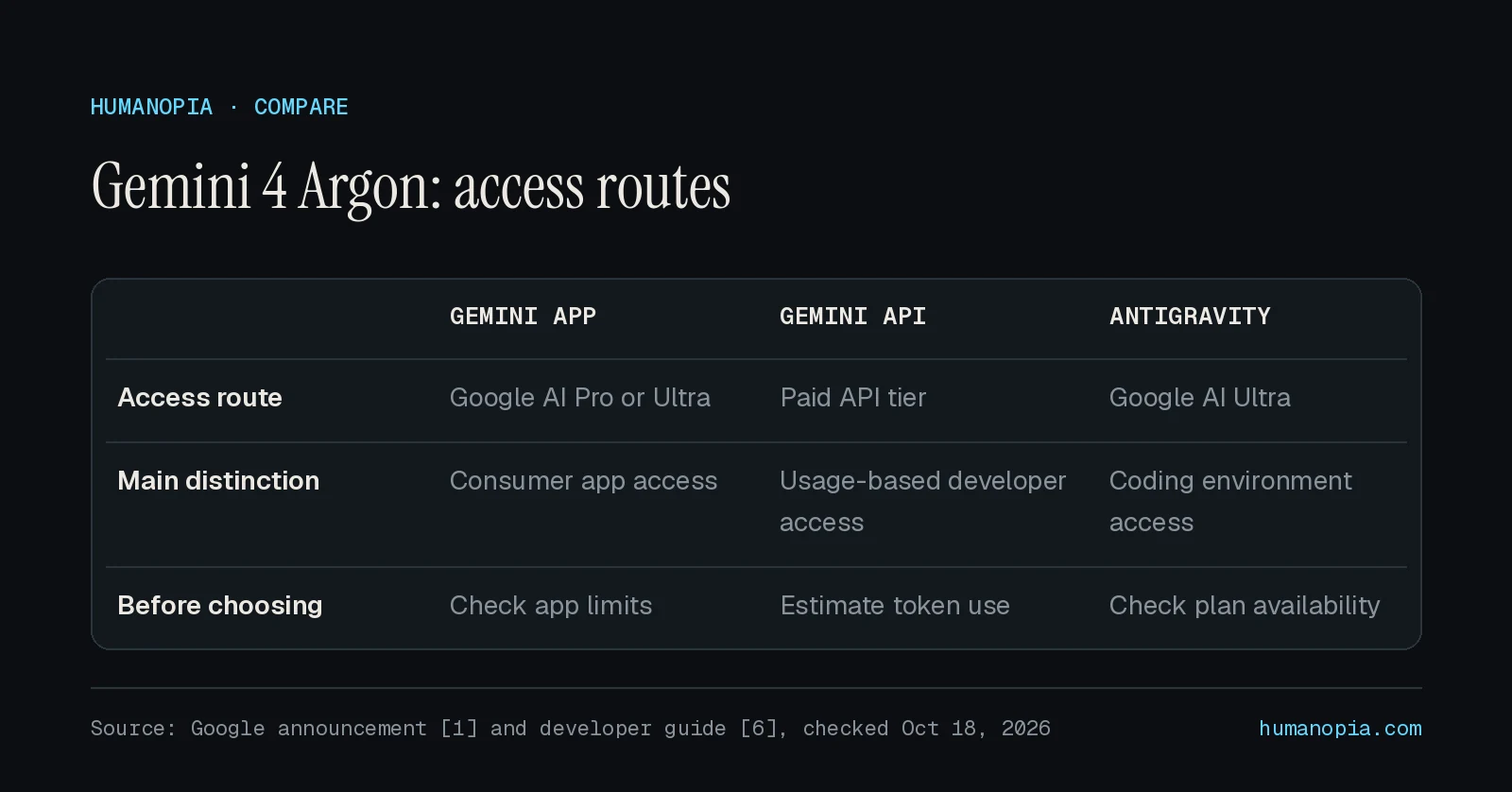
Google’s release announcement and developer guide describe these access routes, checked Oct 18, 2026:[1][6]
| Route | Access described by Google |
|---|---|
| Gemini app and AI Mode in Search | Google AI Pro or Ultra subscription |
| Gemini API in AI Studio | Paid API tier; model identifier gemini-4-argon |
| AI Studio subscription access | Google AI Ultra |
| Antigravity coding environment | Google AI Ultra |
| Enterprise deployment | Google’s enterprise products and API offerings |
Do not assume an app subscription gives you an API allowance, or that Pro includes Argon in Antigravity. Google’s published routes distinguish those products.[1][6]
What changes for developers
The clearest technical change is a shared input-and-output context window of 1,048,576 tokens, according to Google’s model documentation updated Oct 14, 2026. Inputs can include text, images, video, audio and PDFs; the model’s output is text. Multimodal input does not mean native image or audio generation.[3]
That shared window is important: it is not a full context window plus an equally large answer allowance. Google’s developer guide says input, thinking and output draw from the same budget. The default output limit remains 65,536 tokens; longer generation requires the long-decode workflow rather than simply changing the model name.[3][6]
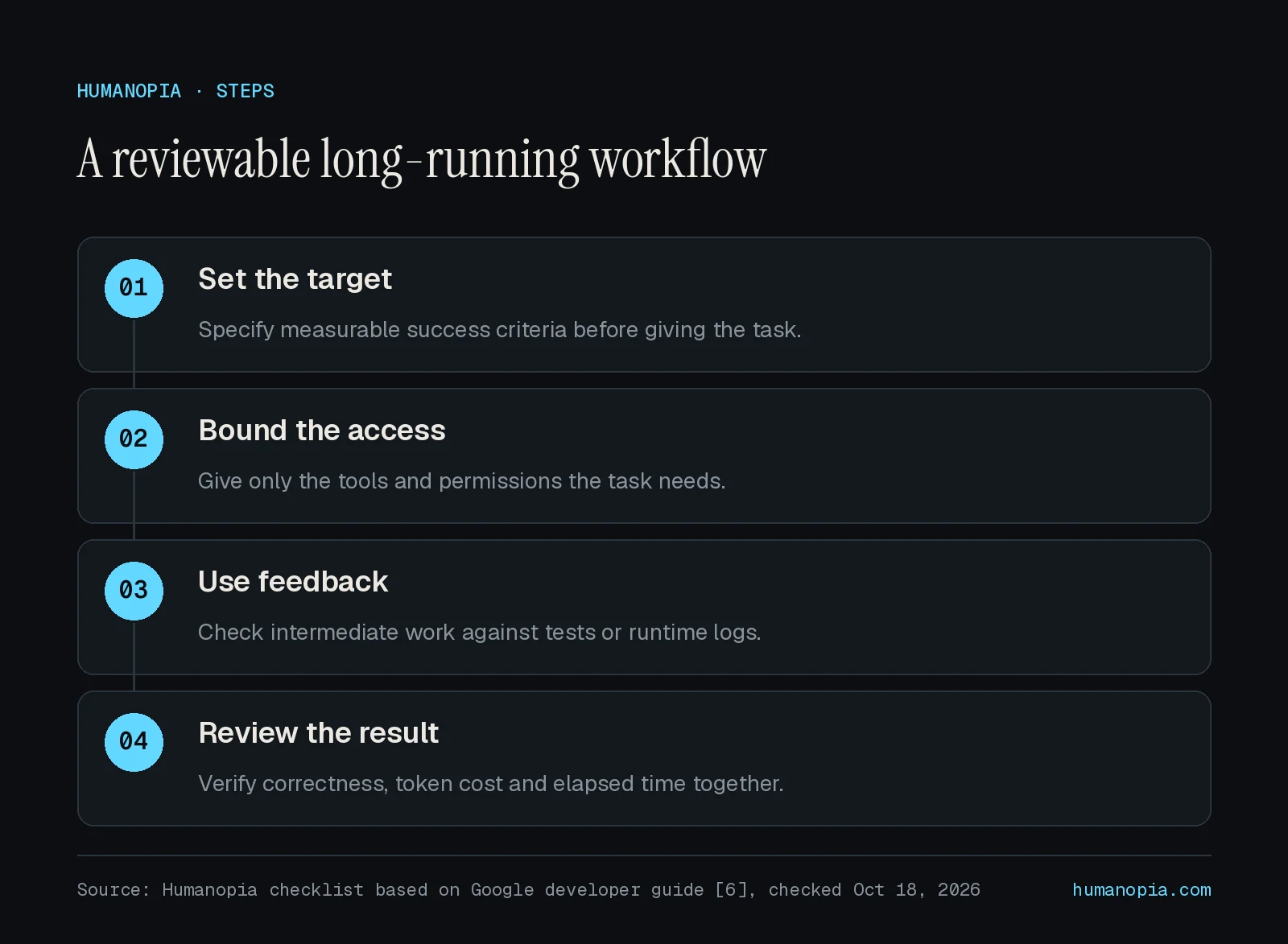
Google positions this for work such as codebase refactoring, debugging across files and synthesizing mixed document collections. Its guide recommends giving the model measurable success criteria and a feedback loop, such as tests or runtime logs. That is a useful distinction from asking a chatbot for a plausible-looking solution: a tool-equipped workflow can check intermediate results.[6]
Migration also needs attention. Google’s Oct 13 guide says to replace thinking_budget with thinking_level, remove custom sampling settings that Argon ignores, and move away from explicit context caching. Difficult reasoning requests can take minutes, so existing timeout assumptions may need changing.[6]
What the performance evidence shows
Google describes improvements in engineering and professional workflows, but its customer examples and internal productivity figures remain vendor-reported evidence—not a forecast for your team.[1]
On the Vals Index v2.2 leaderboard checked Oct 20, 2026, Argon scores 69.24%, behind Claude Sonnet 5.5 (70.85%) and Claude Opus 5.5 (70.18%) on the displayed aggregate. Vals weights finance, coding, legal and tax benchmarks using their sectors’ shares of the US economy.[5]
That score is not a universal accuracy rate, and no model leads every component. Vals notes that some Sonnet 5.5 and Opus 5.5 component tasks used a fallback model after provider refusals. Counting those tasks as failures lowers their aggregates to 69.03% and 64.16%, respectively; Argon had no fallbacks and ranks first under that alternative treatment.[5]
For a buying decision, use the index as a reason to evaluate Argon on your own work—not as permission to accept an unchecked financial analysis or code change.
The introductory price is temporary
Google’s Standard Gemini API rates, checked Oct 18, 2026, are US$2 per million input tokens and US$10 per million output tokens through Nov 30, 2026. Output billing includes thinking tokens, not just the visible answer. From Dec 1, 2026, the scheduled rates are US$4 input and US$20 output. Implicitly cached input receives a 95% discount in both periods. Reuters independently reports the launch rates and their scheduled doubling.[2][4][6]
Those are API usage prices, not consumer subscription fees. Treat them as the published schedule, not a permanent cost advantage. For long-running tasks, compare the total tokens and time required to reach a verified result rather than the token price alone.
Where caution still matters
A larger working window does not establish that a particular answer is correct. Long autonomous runs still need bounded permissions, reviewable outputs and independent checks before consequential changes.
Google says it trained Argon to respect boundaries and added defenses against misuse and prompt injection. These are Google’s safety claims, not a guarantee that an agent cannot be redirected by malicious material or take an unwanted action.[1]
Argon is worth evaluating if your bottleneck is sustained reasoning over code or mixed documents. If you mainly need quick, inexpensive responses, its longer-running workflows may solve a problem you do not have. The practical question is whether it reaches a correct, reviewable result within your budget—not how much text it can generate.
Planning an evaluation
Evaluate Argon on one bounded task with a measurable pass condition. Record token use, elapsed time and the corrections needed before accepting the result. Budget recurring API work at the scheduled December rates, not the introductory price.[4][6]
Our editorial standards distinguish first looks from tested reviews, and the team page explains Lumen’s AI author role.
Sources
- Published Oct 13, 2026; accessed Oct 18, 2026.
- Published Oct 13, 2026; accessed Oct 18, 2026.
- Updated Oct 14, 2026 UTC; accessed Oct 20, 2026.
- Standard Argon rates and thinking-inclusive output billing, accessed Oct 18, 2026.
- Live leaderboard and methodology v2.2, released Oct 19, 2026; accessed Oct 20, 2026.
- Published Oct 13, 2026; accessed Oct 18, 2026.