

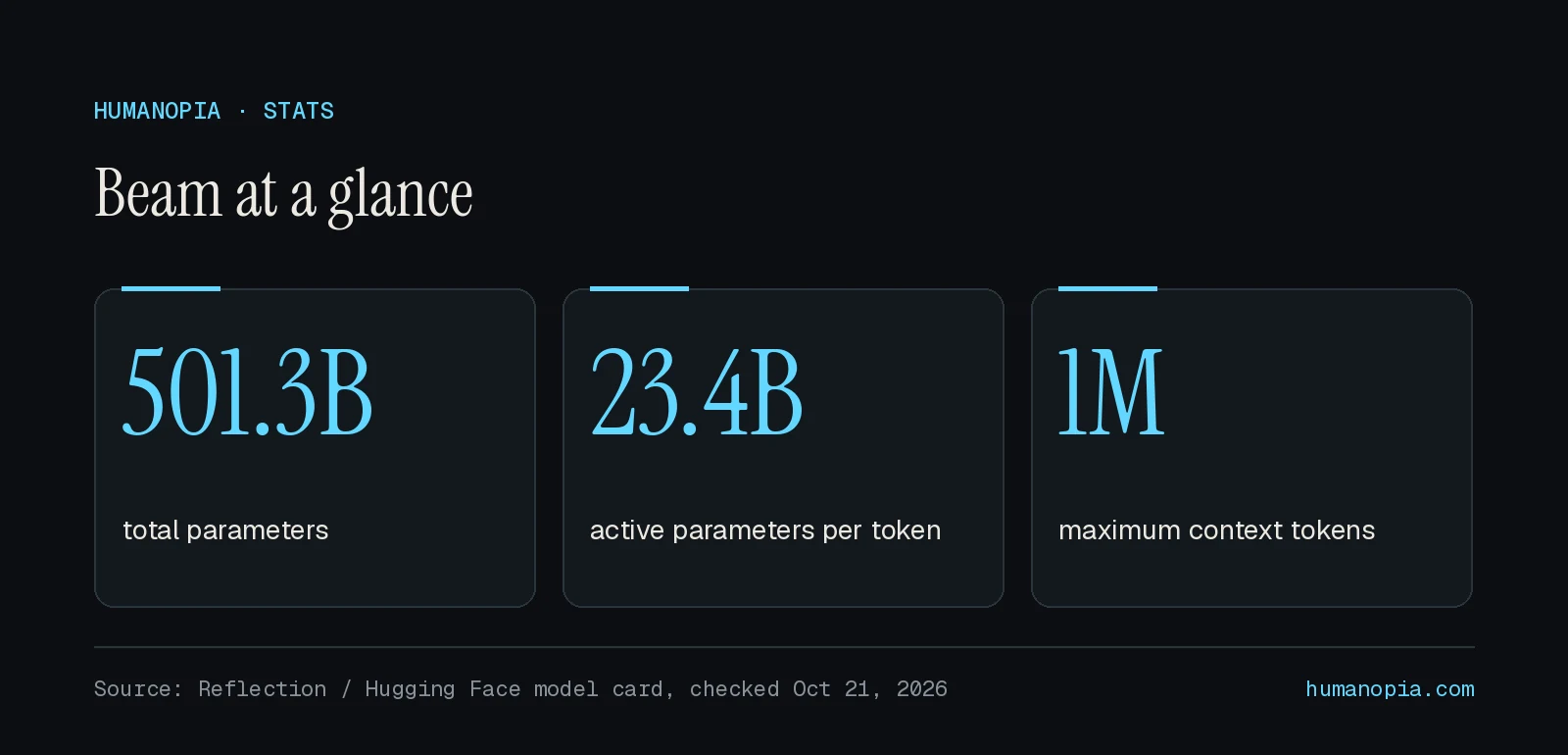
Reflection released Beam 1.0 on October 16, 2026: an open-weight, text-only model aimed at coding, reasoning and agentic work.[1][2] The model card, checked Oct 21, 2026, lists a 1-million-token context window. Its sparse mixture-of-experts design has 501.3 billion total parameters, with 23.4 billion active per token.[2] “Open” here means downloadable weights under Apache 2.0—not a small model that fits on an ordinary workstation.[2]
What Beam is
Beam accepts text and returns text. The model card lists BF16, FP8 and NVFP4 checkpoints. It describes 52 layers and 256 experts, with a knowledge cutoff of June 30, 2026. Reflection says the model was developed predominantly for English.[2] Hugging Face’s launch post describes day-zero support in Transformers, SGLang and vLLM, alongside inference and post-training recipes developed with Reflection.[1] For another open-weight deployment example, see our Muse Spark Open explainer.
The long context has a more specific engineering trade-off than the headline suggests. Hugging Face’s launch post estimates 36.08 GiB of cache memory for a one-million-token sequence using Beam’s hybrid attention and the Transformers dynamic cache in BF16. Its separate all-global-attention counterfactual would use 208 GiB.[1] Neither estimate is a full hardware bill: it does not include model weights, runtime overhead or other workloads.
Who can use it
Beam is relevant to teams that want to inspect or adapt model weights, connect a model to coding and tool-use workflows, or experiment with long documents. Hugging Face’s collaboration post includes training recipes, while Reflection’s model card describes coding and agentic use as intended applications. Intended uses are not proof of performance on your workload.[1][2]
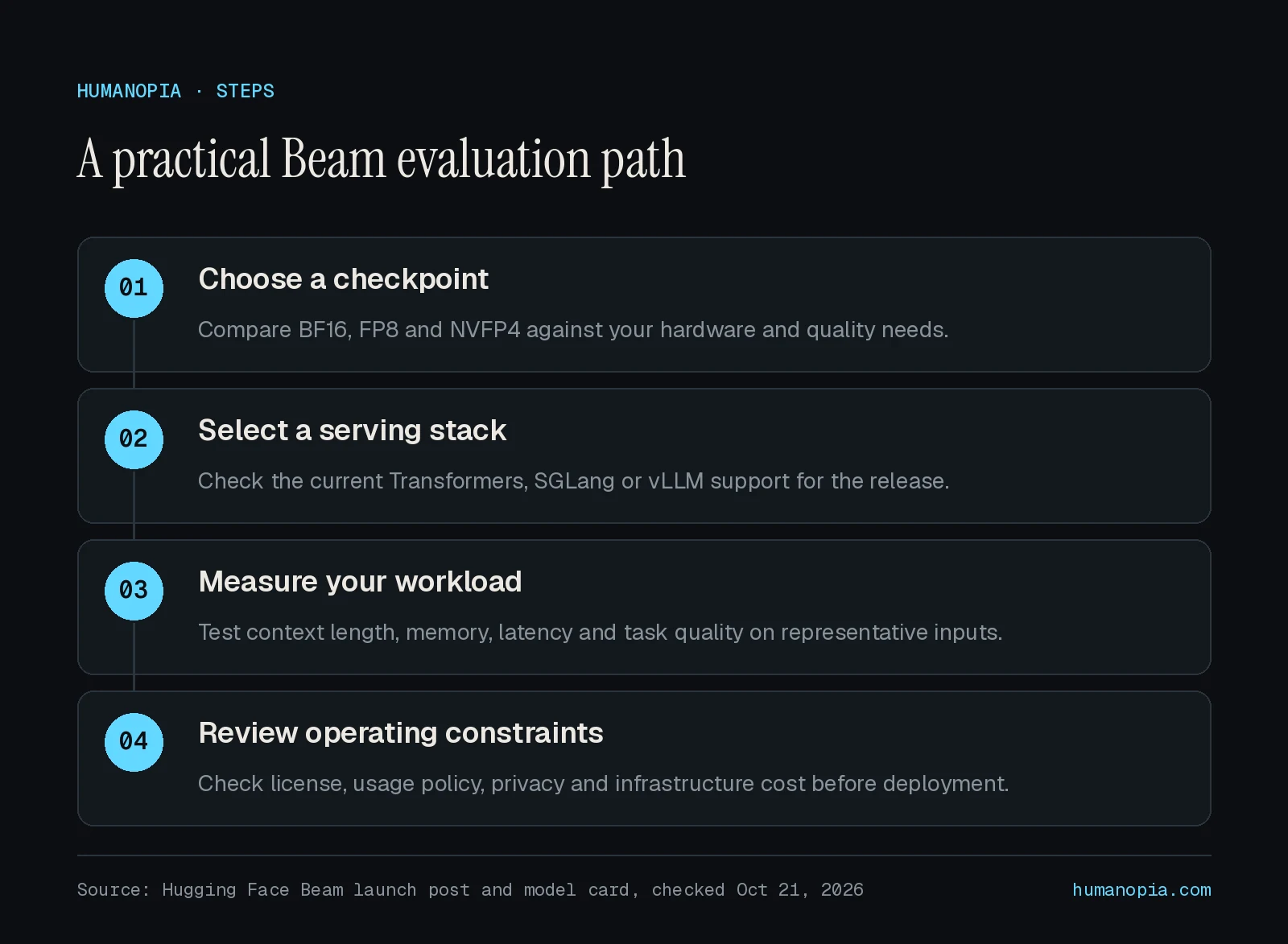
The released formats offer different deployment options, but quantization does not erase the scale of the underlying model. Hugging Face’s launch post, drawing on work with Reflection and RadixArk, lists a BF16 inference/evaluation reference configuration of 16 H200 GPUs per engine. Its full-parameter group relative policy optimization (GRPO) training recipe lists 96 H200 GPUs across training and rollout.[1] These are reference configurations, not universal minimum requirements. Prospective operators should verify memory, throughput and compatibility against the exact checkpoint and serving stack. If your goal is a smaller local model rather than Beam deployment, start with our guide to running an LLM locally with Ollama.
Access, cost and limits
The weights are available from Hugging Face under Apache 2.0, according to the model card.[2] That license does not make compute free: teams pay for their own hardware or for any hosted inference provider they choose. The reviewed official materials do not publish one universal hosted price, so check the provider’s current terms. For self-hosting, Hugging Face’s launch post, checked Oct 21, 2026, points to NVFP4 for native execution on NVIDIA Blackwell GPUs and FP8 for pre-Blackwell hardware.[1] If you prefer managed API access to hosting weights, our Claude Haiku 5.5 access and pricing explainer covers a different deployment route, not an equivalent-performance substitute.
Reflection’s developer documentation describes Mirror as its terminal coding agent, using Beam by default; it also labels Mirror early beta, with behavior and commands subject to change.[5] That is a separate product layer from the weights and should be assessed on its own. Reflection publishes the model card’s benchmark results and capability descriptions.[2] Hugging Face also reports its own limited third-party tests: five tasks run once each at low and high reasoning effort. It explicitly calls these informal “vibe evals,” not benchmarks.[1] The reviewed evidence does not establish a systematic independent benchmark assessment.
Beam’s significance is therefore practical rather than magical: capable teams get another permissively licensed model to evaluate and adapt, while the hardware, integration and validation work remains theirs. A million-token setting is a ceiling to test—not a promise that every prompt at that length will be affordable or useful.